


Page 314 - Le Operazioni Interforze e Multinazionali nella Storia Militare - ACTA Tomo I
P. 314
314                                XXXIX Congresso della CommIssIone InternazIonale dI storIa mIlItare • CIHm

              The Commission’s work was remarkable, and this had been stated in their memories
           also by protagonists, by the military and by the few scholars who had dealt with it, in
           their sort of success story. But the study of archival documentation revealed a much less
           linear, peaceful and concordant arrangement of what everybody was interested in seeing
           as a success story, that could be thought of by studying only the propaganda products,
           namely the leaflets.
              On the contrary it is certain that the propaganda played its role in contributing to
           destroy  the consensus in Wien (and, analogously, it would not be wrong to think that it
           also played a relevant role in creating an internal Italian consensus). The Great War was
           not only or very spontaneously “felt” by the soldiers as much as “fabricated”: what the
           most critical historians had thought was thus confirmed.
              Though remaining a propaganda battle of huge dimensions, the one between Italians
           and Austrians started late (few months in 1918) and the communication techniques used
           by the Italians were not always the most up-to-date. To Mark Cornwall, who studied it
           after Austrian or Slav sources, must be acknowledged the great merit of having being
           the first who thoroughly examined it, although the fact that he completely ignored Italian
           sources  led him to emphasize more than what was due the object of his studies and to
           ignore the difficult and often contradictory Italian dynamics which were instead decisive
           in the Commission’s history.
              But commenting on single scholars is not relevant. The meaning of this remark is
           more general, namely that the war propaganda cannot be studied only according to its
           products without investigating, and thoroughly, the complex and often conflicting pro-
           cesses of its production. In the case of the Inter-allied Commission and of the propa-
           ganda for the Austrian enemy, none of his makers, be he civilian or military, Italian or
           foreign, seems innocent, although obviously with different levels of responsibility or, on
           the opposite, of merit, for a battle which was nonetheless fought, and won, by the Ital-
           ians and by the allies.


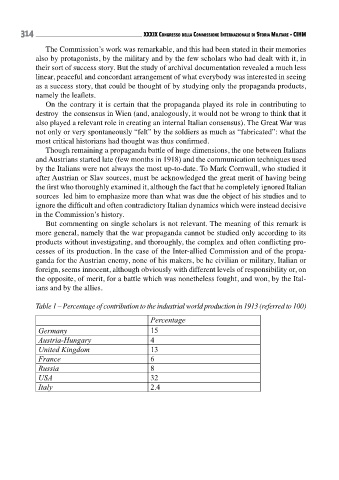
           Table 1 – Percentage of contribution to the industrial world production in 1913 (referred to 100)
                                            Percentage
            Germany                         15
            Austria-Hungary                 4
            United Kingdom                  13
            France                          6
            Russia                          8
            USA                             32
            Italy                           2.4

