


Page 318 - Le Operazioni Interforze e Multinazionali nella Storia Militare - ACTA Tomo I
P. 318
318                                XXXIX Congresso della CommIssIone InternazIonale dI storIa mIlItare • CIHm

           on Dunkerque and Calais. Each should be blocked by the sinking of two to three ob-
           solete battleships or cruisers in a way that hampered salvage. Cranes, docks and locks
           should be destroyed by demolition.  The preparations should take place without delay.
           A detailed plan should be developed together with Keyes. At the same these three ports
           and Havre and St. Nazaire should be prepared defended a German blocking attempt
           with block ships masked as merchant ships that could take place linked to a German
           offensive under cover of a battle-cruiser raid. The French should be notified of the risk.
           Fuller’s superior, the Deputy Chief of the Naval Staff, Vice-Admiral Sydney Fremantle,
           supported him and noted that other naval authorities, the British Army and both French
           armed services needed to be involved. However, the Chief of the Naval Staff, Admiral
           Rosslyn Wemyss disagreed. He noted on 16 February that no preparations or other steps
           should be taken at that time. 4

           Alexander Gibb
              Early 1918 the civil engineer Alexander Gibb
           had been headhunted by his mentor, Eric Ged-
           des. Geddes was a competent former railway
           manager who had previously been successfully
           employed to create an effective logistic rear for
           the British Army in France. The Prime Minister,
           David Lloyd George, had thereafter moved him
           to the Admiralty to reorganise ship construction,
           and soon the self-conscious manager had been
           promoted to the War Cabinet as First Lord of
           the Admiralty with authority to control the ad-
           mirals.
              It was the second time  that Geddes used
           Gibb. He had earlier  hired  Gibb in France  to
           prepare to bring the German controlled Belgian
           ports of Zeebrugge and Ostend back into use
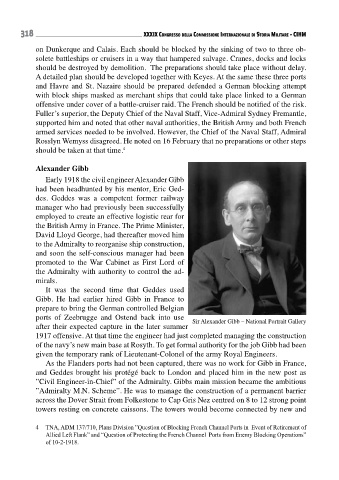
                                                        Sir Alexander Gibb – National Portrait Gallery
           after their expected capture in the later summer
           1917 offensive. At that time the engineer had just completed managing the construction
           of the navy’s new main base at Rosyth. To get formal authority for the job Gibb had been
           given the temporary rank of Lieutenant-Colonel of the army Royal Engineers.
              As the Flanders ports had not been captured, there was no work for Gibb in France,
           and Geddes brought his protégé back to London and placed him in the new post as
           ”Civil Engineer-in-Chief” of the Admiralty. Gibbs main mission became the ambitious
           ”Admiralty M.N. Scheme”. He was to manage the construction of a permanent barrier
           across the Dover Strait from Folkestone to Cap Gris Nez centred on 8 to 12 strong point
           towers resting on concrete caissons. The towers would become connected by new and

           4    TNA, ADM 137/710, Plans Division ”Question of Blocking French Channel Ports in  Event of Retirement of
              Allied Left Flank” and “Question of Protecting the French Channel  Ports from Enemy Blocking Operations”
              of 10-2-1918.

