


Page 70 - Le Operazioni Interforze e Multinazionali nella Storia Militare - ACTA Tomo II
P. 70
710                                XXXIX Congresso della CommIssIone InternazIonale dI storIa mIlItare • CIHm

           the UN which would then submit a formal protest to the relevant Serbian, Bosnian or
           Croatian authorities.
              In September 1992, the STANAVFORMED force was relieved by NATO’s Standing
           Naval Force Atlantic (STANAVFORLANT) for three weeks and since Danish corvette
           Niels Juel was part of this force at the time , it naturally became part of the MARITIME
           MONITOR operation.

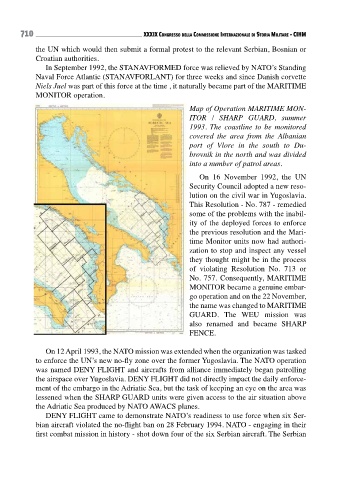
                                                       Map of Operation MARITIME MON-
                                                       ITOR  /  SHARP  GUARD,  summer
                                                       1993. The coastline to be monitored
                                                       covered  the  area  from the  Albanian
                                                       port of  Vlore  in  the  south to  Du-
                                                       brovnik in the north and was divided
                                                       into a number of patrol areas.

                                                          On 16 November 1992, the UN
                                                       Security Council adopted a new reso-
                                                       lution on the civil war in Yugoslavia.
                                                       This Resolution - No. 787 - remedied
                                                       some of the problems with the inabil-
                                                       ity of the deployed forces to enforce
                                                       the previous resolution and the Mari-
                                                       time Monitor units now had authori-
                                                       zation to stop and inspect any vessel
                                                       they thought might be in the process
                                                       of violating Resolution No. 713 or
                                                       No. 757. Consequently, MARITIME
                                                       MONITOR became a genuine embar-
                                                       go operation and on the 22 November,
                                                       the name was changed to MARITIME
                                                       GUARD. The  WEU  mission  was
                                                       also renamed and became  SHARP
                                                       FENCE.

              On 12 April 1993, the NATO mission was extended when the organization was tasked
           to enforce the UN’s new no-fly zone over the former Yugoslavia. The NATO operation
           was named DENY FLIGHT and aircrafts from alliance immediately began patrolling
           the airspace over Yugoslavia. DENY FLIGHT did not directly impact the daily enforce-
           ment of the embargo in the Adriatic Sea, but the task of keeping an eye on the area was
           lessened when the SHARP GUARD units were given access to the air situation above
           the Adriatic Sea produced by NATO AWACS planes.
              DENY FLIGHT came to demonstrate NATO’s readiness to use force when six Ser-
           bian aircraft violated the no-flight ban on 28 February 1994. NATO - engaging in their
           first combat mission in history - shot down four of the six Serbian aircraft. The Serbian

