


Page 74 - Le Operazioni Interforze e Multinazionali nella Storia Militare - ACTA Tomo II
P. 74
714                                XXXIX Congresso della CommIssIone InternazIonale dI storIa mIlItare • CIHm

           real deal” and not an exercise, the day-to-day work did not differ much.
              The Danish corvettes were - as usual - the smallest units in the task force and also
           the units with the shortest possible sea time. On the other hand, the corvettes were fully
           capable of executing the required tasks to everyone’s satisfaction.
           For most of the crew, the daily routines aboard the ships were almost the same as they
           would have been had the corvettes been operating anywhere else in the world. But offic-
           ers, the combat information specialists in the Operations Room and the boarding teams
           came to experience firsthand that they were part of a major international operation far
           from home. For the majority of the crew, the highlights were port visits in Italian cities
           such as Bari, Brindisi and Venice.

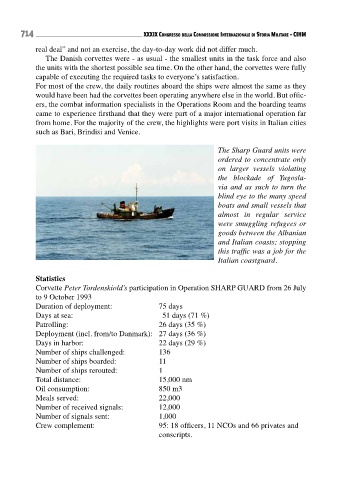
                                                               The Sharp Guard units were
                                                               ordered to concentrate only
                                                               on larger vessels violating
                                                               the  blockade  of Yugosla-
                                                               via and as such to turn the
                                                               blind eye to the many speed
                                                               boats and small vessels that
                                                               almost in regular service
                                                               were smuggling refugees or
                                                               goods between the Albanian
                                                               and Italian coasts; stopping
                                                               this traffic was a job for the
                                                               Italian coastguard.

           Statistics
           Corvette Peter Tordenskiold’s participation in Operation SHARP GUARD from 26 July

           to 9 October 1993
           Duration of deployment:            75 days
           Days at sea:                         51 days (71 %)
           Patrolling:                        26 days (35 %)
           Deployment (incl. from/to Danmark):  27 days (36 %)
           Days in harbor:                    22 days (29 %)
           Number of ships challenged:        136
           Number of ships boarded:           11
           Number of ships rerouted:          1
           Total distance:                    15,000 nm
           Oil consumption:                   850 m3
           Meals served:                      22,000
           Number of received signals:        12,000
           Number of signals sent:            1,000
           Crew complement:                   95: 18 officers, 11 NCOs and 66 privates and
                                              conscripts.

