


Page 77 - Le Operazioni Interforze e Multinazionali nella Storia Militare - ACTA Tomo II
P. 77
717
          ActA
          and Montenegro - and ships bound for Bosnia could be inspected by other Sharp Guard
          units.

             On 21 November 1995, a peace agreement was finally reached at Wright-Patterson
          Air Force Base near Dayton, Ohio. The peace agreement came into force on 14 Decem-
          ber 1995 and after a period where everybody waited to see if the agreement held, the
          arms embargo against the former Yugoslavia was partially lifted on 13 March 1996. The
          SHARP GUARD units remained in place, ready to resume enforcement of the embargo
          if needed. This did not become necessary, however, and the embargo was finally lifted
          on 18 June. The next day, Operation SHARP GUARD was suspended.
             On 1 October 1996, the UN lifted  all  sanctions against  Serbia and Montenegro,
          meaning that Operation SHARP GUARD was officially over.

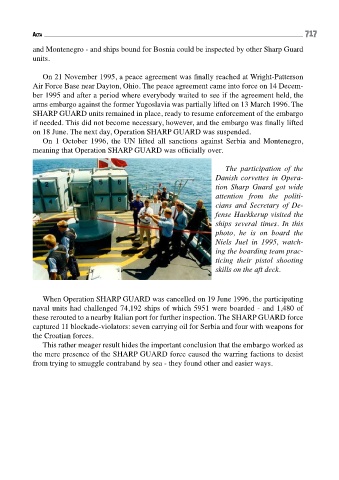
                                                                 The  participation  of  the
                                                              Danish corvettes in Opera-
                                                              tion Sharp Guard got wide
                                                              attention  from the  politi-
                                                              cians and Secretary of De-
                                                              fense Haekkerup visited the
                                                              ships several times. In this
                                                              photo, he is on board the
                                                              Niels Juel  in 1995, watch-
                                                              ing the boarding team prac-
                                                              ticing their pistol shooting
                                                              skills on the aft deck.


             When Operation SHARP GUARD was cancelled on 19 June 1996, the participating
          naval units had challenged 74,192 ships of which 5951 were boarded - and 1,480 of
          these rerouted to a nearby Italian port for further inspection. The SHARP GUARD force
          captured 11 blockade-violators: seven carrying oil for Serbia and four with weapons for
          the Croatian forces.
             This rather meager result hides the important conclusion that the embargo worked as
          the mere presence of the SHARP GUARD force caused the warring factions to desist
          from trying to smuggle contraband by sea - they found other and easier ways.

