


Page 72 - Le Operazioni Interforze e Multinazionali nella Storia Militare - ACTA Tomo II
P. 72
712                                XXXIX Congresso della CommIssIone InternazIonale dI storIa mIlItare • CIHm

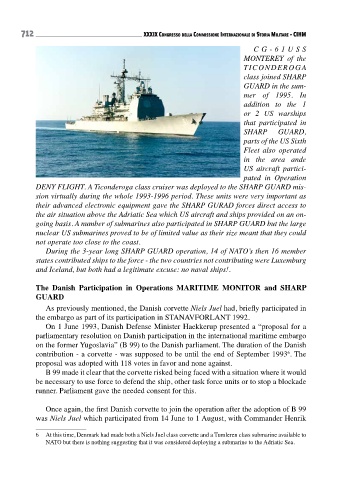
                                                                         CG-61USS
                                                                      MONTEREY of the
                                                                      TICONDEROGA
                                                                      class joined SHARP
                                                                      GUARD in the sum-
                                                                      mer  of 1995. In
                                                                      addition to the 1
                                                                      or  2  US  warships
                                                                      that participated  in
                                                                      SHARP     GUARD,
                                                                      parts of the US Sixth
                                                                      Fleet  also operated
                                                                      in  the  area  ande
                                                                      US  aircraft  partici-
                                                                      pated in Operation

           DENY FLIGHT. A Ticonderoga class cruiser was deployed to the SHARP GUARD mis-
           sion virtually during the whole 1993-1996 period. These units were very important as
           their advanced electronic equipment gave the SHARP GURAD forces direct access to
           the air situation above the Adriatic Sea which US aircraft and ships provided on an on-
           going basis. A number of submarines also participated in SHARP GUARD but the large
           nuclear US submarines proved to be of limited value as their size meant that they could
           not operate too close to the coast.
              During the 3-year long SHARP GUARD operation, 14 of NATO’s then 16 member
           states contributed ships to the force - the two countries not contributing were Luxemburg
           and Iceland, but both had a legitimate excuse: no naval ships!.

           The Danish  Participation in Operations MARITIME  MONITOR and  SHARP
           GUARD
              As previously mentioned, the Danish corvette Niels Juel had, briefly participated in
           the embargo as part of its participation in STANAVFORLANT 1992.
              On 1 June 1993, Danish Defense Minister Haekkerup presented a “proposal for a
           parliamentary resolution on Danish participation in the international maritime embargo
           on the former Yugoslavia” (B 99) to the Danish parliament. The duration of the Danish
           contribution - a corvette - was supposed to be until the end of September 1993 . The
                                                                                   6
           proposal was adopted with 118 votes in favor and none against.
              B 99 made  it clear that the corvette risked being faced with a situation where it would

           be necessary to use force to defend the ship, other task force units or to stop a blockade
           runner. Parliament gave the needed consent for this.

              Once again, the first Danish corvette to join the operation after the adoption of B 99
           was Niels Juel which participated from 14 June to 1 August, with Commander Henrik

           6    At this time, Denmark had made both a Niels Juel class corvette and a Tumleren class submarine  available to
              NATO but there is nothing suggesting that it was considered deploying a submarine to the Adriatic Sea.

