


Page 67 - Le Operazioni Interforze e Multinazionali nella Storia Militare - ACTA Tomo II
P. 67
707
          ActA
          The Participation of the Danish Navy in Operation
          Maritime Monitor / Sharp Guard 1993-1996


          Søren NøRBY


          When Danish corvette Olfert
          Fischer  joined  the  UN  op-
          eration against Iraq in 1990-
          1991, it was seen as the most
          significant sign of the chang-
          ing security situation  which
          Denmark and the Navy were
          facing following the fall of
          the  Berlin  Wall  in  1989  and
          the subsequent collapse of the
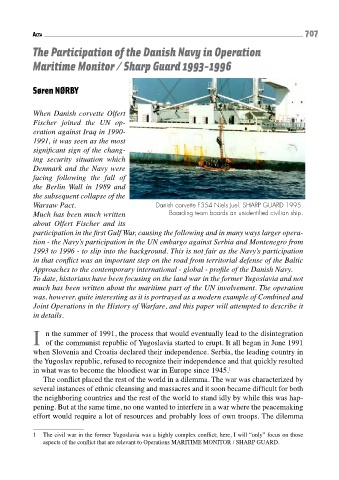
          Warsaw Pact.                       Danish corvette F354 Niels Juel. SHARP GUARD 1995.
          Much has been much written             Boarding team boards an unidentified civilian ship.
          about Olfert Fischer and its
          participation in the first Gulf War, causing the following and in many ways larger opera-
          tion - the Navy’s participation in the UN embargo against Serbia and Montenegro from
          1993 to 1996 - to slip into the background. This is not fair as the Navy’s participation
          in that conflict was an important step on the road from territorial defense of the Baltic
          Approaches to the contemporary international - global - profile of the Danish Navy.
          To date, historians have been focusing on the land war in the former Yugoslavia and not
          much has been written about the maritime part of the UN involvement. The operation
          was, however, quite interesting as it is portrayed as a modern example of Combined and
          Joint Operations in the History of Warfare, and this paper will attempted to describe it
          in details.

              n the summer of 1991, the process that would eventually lead to the disintegration
          I of the communist republic of Yugoslavia started to erupt. It all began in June 1991
          when Slovenia and Croatia declared their independence. Serbia, the leading country in
          the Yugoslav republic, refused to recognize their independence and that quickly resulted
          in what was to become the bloodiest war in Europe since 1945. 1
             The conflict placed the rest of the world in a dilemma. The war was characterized by
          several instances of ethnic cleansing and massacres and it soon became difficult for both
          the neighboring countries and the rest of the world to stand idly by while this was hap-
          pening. But at the same time, no one wanted to interfere in a war where the peacemaking
          effort would require a lot of resources and probably loss of own troops. The dilemma

          1    The civil war in the former Yugoslavia was a highly complex conflict; here, I will “only” focus on those
             aspects of the conflict that are relevant to Operations MARITIME MONITOR / SHARP GUARD.

