


Page 68 - Le Operazioni Interforze e Multinazionali nella Storia Militare - ACTA Tomo II
P. 68
708                                XXXIX Congresso della CommIssIone InternazIonale dI storIa mIlItare • CIHm

           was formulated very precisely by the then U.S. Secretary of State James Baker when he
           said that “We do not have a dog in that fight” by which he meant that Americans had
           nothing to gain by interfering. 2
              The many TV images of dead, wounded or displaced people, however, caused the
           people of the United States and Europe to demand that their respective governments
           “did something”. This so-called “CNN effect” was instrumental in the process which
           on September 25, 1991, resulted in the UN adopting the first resolution on the war in
           Yugoslavia. This resolution, number 713, imposed an arms embargo against what was
           by then known as the Former Republic of Yugoslavia (FRY).

                                                                     The outbreak of the
                                                                   civil  war in Yugosla-
                                                                   via was overshadowed
                                                                   by  Iraq’s  occupation  of
                                                                   neighboring Kuwait. It
                                                                   was  not  until  the  U.S.
                                                                   led operation to liber-
                                                                   ate Kuwait was over in
                                                                   the spring of 1991 that
                                                                   the civil war in Yugosla-
                                                                   via moved to the front of
                                                                   the world’s newspapers.
                                                                   When the Yugoslav civil
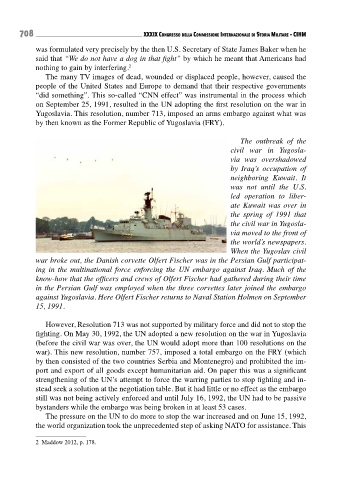
             war broke out, the Danish corvette Olfert Fischer was in the Persian Gulf participat-
           ing in the multinational force enforcing the UN embargo against Iraq. Much of the
           know-how that the officers and crews of Olfert Fischer had gathered during their time
           in the Persian Gulf was employed when the three corvettes later joined the embargo
           against Yugoslavia. Here Olfert Fischer returns to Naval Station Holmen on September
           15, 1991.

              However, Resolution 713 was not supported by military force and did not to stop the
           fighting. On May 30, 1992, the UN adopted a new resolution on the war in Yugoslavia
           (before the civil war was over, the UN would adopt more than 100 resolutions on the
           war). This new resolution, number 757, imposed a total embargo on the FRY (which
           by then consisted of the two countries Serbia and Montenegro) and prohibited the im-
           port and export of all goods except humanitarian aid. On paper this was a significant
           strengthening of the UN’s attempt to force the warring parties to stop fighting and in-
           stead seek a solution at the negotiation table. But it had little or no effect as the embargo
           still was not being actively enforced and until July 16, 1992, the UN had to be passive
           bystanders while the embargo was being broken in at least 53 cases.
              The pressure on the UN to do more to stop the war increased and on June 15, 1992,
           the world organization took the unprecedented step of asking NATO for assistance. This

           2  Maddow 2012, p. 178.

