


Page 73 - Le Operazioni Interforze e Multinazionali nella Storia Militare - ACTA Tomo II
P. 73
713
          ActA
          Muusfeldt as commanding officer. He had been the commanding officer of Olfert Fis-
          cher when it participated in the (first) Gulf War, meaning that he had personal experience
          from such multinational operations.
             The following three years, the three Niels Juel class corvettes partook in the joined
                                                                        7
          SHARP GUARD mission seven times, each tour lasting three months .
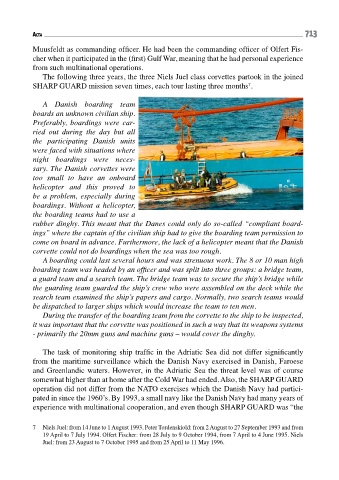
             A Danish boarding team
          boards an unknown civilian ship.
          Preferably, boardings were car-
          ried  out  during the  day  but all
          the participating  Danish units
          were faced with situations where
          night  boardings  were  neces-
          sary. The Danish corvettes were
          too  small  to  have  an  onboard
          helicopter  and this proved to
          be a problem, especially during
          boardings. Without a helicopter,
          the boarding teams had to use a
          rubber dinghy. This meant that the Danes could only do so-called “compliant board-
          ings” where the captain of the civilian ship had to give the boarding team permission to
          come on board in advance. Furthermore, the lack of a helicopter meant that the Danish
          corvette could not do boardings when the sea was too rough.
             A boarding could last several hours and was strenuous work. The 8 or 10 man high
          boarding team was headed by an officer and was split into three groups: a bridge team,
          a guard team and a search team. The bridge team was to secure the ship’s bridge while
          the guarding team guarded the ship’s crew who were assembled on the deck while the
          search team examined the ship’s papers and cargo. Normally, two search teams would
          be dispatched to larger ships which would increase the team to ten men.
             During the transfer of the boarding team from the corvette to the ship to be inspected,
          it was important that the corvette was positioned in such a way that its weapons systems
          - primarily the 20mm guns and machine guns – would cover the dinghy.


             The task of monitoring ship traffic in the Adriatic Sea did not differ significantly
          from the maritime surveillance which the Danish Navy exercised in Danish, Faroese
          and Greenlandic waters. However, in the Adriatic Sea the threat level was of course
          somewhat higher than at home after the Cold War had ended. Also, the SHARP GUARD
          operation did not differ from the NATO exercises which the Danish Navy had partici-
          pated in since the 1960’s. By 1993, a small navy like the Danish Navy had many years of
          experience with multinational cooperation, and even though SHARP GUARD was “the

          7   Niels Juel: from 14 June to 1 August 1993. Peter Tordenskiold: from 2 August to 27 September 1993 and from
             19 April to 7 July 1994. Olfert Fischer: from 28 July to 9 October 1994, from 7 April to 4 June 1995. Niels
             Juel: from 23 August to 7 October 1995 and from 25 April to 11 May 1996.

