


Page 76 - Le Operazioni Interforze e Multinazionali nella Storia Militare - ACTA Tomo II
P. 76
716                                XXXIX Congresso della CommIssIone InternazIonale dI storIa mIlItare • CIHm

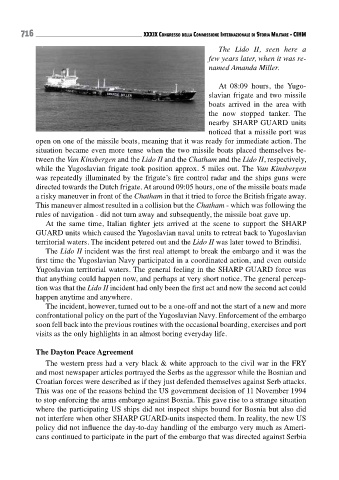
                                                               The Lido II, seen here a
                                                            few years later, when it was re-
                                                            named Amanda Miller.


                                                               At 08:09 hours, the  Yugo-
                                                            slavian frigate and two missile
                                                            boats arrived in the area with
                                                            the now stopped tanker.  The
                                                            nearby SHARP GUARD units
                                                            noticed that a missile port was
           open on one of the missile boats, meaning that it was ready for immediate action. The
           situation became even more tense when the two missile boats placed themselves be-
           tween the Van Kinsbergen and the Lido II and the Chatham and the Lido II, respectively,
           while the Yugoslavian frigate took position approx. 5 miles out. The Van Kinsbergen
           was repeatedly illuminated by the frigate’s fire control radar and the ships guns were
           directed towards the Dutch frigate. At around 09:05 hours, one of the missile boats made
           a risky maneuver in front of the Chatham in that it tried to force the British frigate away.
           This maneuver almost resulted in a collision but the Chatham - which was following the
           rules of navigation - did not turn away and subsequently, the missile boat gave up.
              At  the  same  time,  Italian  fighter  jets  arrived  at  the  scene  to  support  the  SHARP
           GUARD units which caused the Yugoslavian naval units to retreat back to Yugoslavian
           territorial waters. The incident petered out and the Lido II was later towed to Brindisi.
              The Lido II incident was the first real attempt to break the embargo and it was the
           first time the Yugoslavian Navy participated in a coordinated action, and even outside
           Yugoslavian territorial waters. The general feeling in the SHARP GUARD force was
           that anything could happen now, and perhaps at very short notice. The general percep-
           tion was that the Lido II incident had only been the first act and now the second act could
           happen anytime and anywhere.
              The incident, however, turned out to be a one-off and not the start of a new and more
           confrontational policy on the part of the Yugoslavian Navy. Enforcement of the embargo
           soon fell back into the previous routines with the occasional boarding, exercises and port
           visits as the only highlights in an almost boring everyday life.


           The Dayton Peace Agreement
              The western press had a very black & white approach to the civil war in the FRY
           and most newspaper articles portrayed the Serbs as the aggressor while the Bosnian and
           Croatian forces were described as if they just defended themselves against Serb attacks.
           This was one of the reasons behind the US government decision of 11 November 1994
           to stop enforcing the arms embargo against Bosnia. This gave rise to a strange situation
           where the participating US ships did not inspect ships bound for Bosnia but also did
           not interfere when other SHARP GUARD-units inspected them. In reality, the new US
           policy did not influence the day-to-day handling of the embargo very much as Ameri-
           cans continued to participate in the part of the embargo that was directed against Serbia

