


Page 372 - Lanzarotto Malocello from Italy to the Canary Islands
P. 372
372                                             from Italy to the Canary Islands


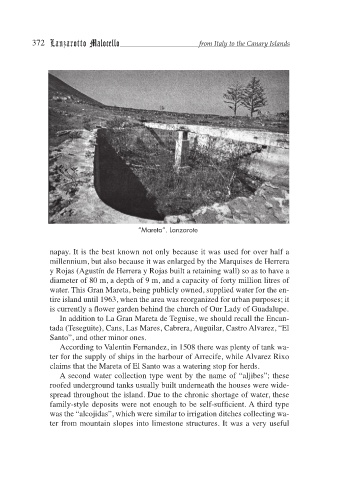
                                        “Mareta”. Lanzarote


               napay. It is the best known not only because it was used for over half a
               millennium, but also because it was enlarged by the Marquises de Herrera
               y Rojas (Agustín de Herrera y Rojas built a retaining wall) so as to have a
               diameter of 80 m, a depth of 9 m, and a capacity of forty million litres of
               water. This Gran Mareta, being publicly owned, supplied water for the en-
               tire island until 1963, when the area was reorganized for urban purposes; it
               is currently a flower garden behind the church of Our Lady of Guadalupe.
                  In addition to La Gran Mareta de Teguise, we should recall the Encan-
               tada (Teseguite), Cans, Las Mares, Cabrera, Auguilar, Castro Alvarez, “El
               Santo”, and other minor ones.
                  According to Valentin Fernandez, in 1508 there was plenty of tank wa-
               ter for the supply of ships in the harbour of Arrecife, while Alvarez Rixo
               claims that the Mareta of El Santo was a watering stop for herds.
                  A second water collection type went by the name of “aljibes”; these
               roofed underground tanks usually built underneath the houses were wide-
               spread throughout the island. Due to the chronic shortage of water, these
               family-style deposits were not enough to be self-sufficient. A third type
               was the “alcojidas”, which were similar to irrigation ditches collecting wa-
               ter from mountain slopes into limestone structures. It was a very useful

