


Page 112 - Lanzarotto Malocello from Italy to the Canary Islands
P. 112
112                                             from Italy to the Canary Islands


               in Palestine, in 1258, certainly happened. If these events occurred under
               his Magistrature, it is also true that throughout his government he really
               strived to put right the state finances with the clear aim of buffering the
               domestic economic crisis started in 1255 and caused by the stop to produc-
               tion in shipyards and in the wool sector, too. There was therefore a credit
               and currency crisis. The sufferers of these were “the common craftsmen,
               who had by now decided to seek their rights and not allow the old system
               of purchasing public income to carry on, impoverishing the revenue in
               favour of the privileged class, directly or indirectly involved in the govern-
               ment” (Teofilo Ossian De Negri).
                  These operations to contain the crisis – we could say “public health”
               measures – were met with a conspiracy plotted by the aristocracy, which
               was foiled, causing a very strong reaction by the Captain of the People.
                  If a defeat like the one in Acre can “tarnish”, so to say, a government
               (in fact, the skirmishes between Genoa and Venice had started before Boc-
               canegra came to power), it is also true that during his Magistrature impor-
               tant agreements were reached for Genoa with the Treaty of Nymphaeum
               of 1261.
                  The Acre event, in which the Venetians and the Pisans – Lorenzo
               Tiepolo with Andrea Zeno and Lorenzo Barassi against Genoa’s
               thirty-five  galleys  and  four  ships,  led  by  Rosso  della  Tur-
               ca – defeated the Genoese, could have happened in the
               Mediterranean,  in the  Tyrrhenian and in the
               Holy Land (Pisa seemed to have picked itself
               up again and appeared to have assumed once
               more  a  bellicose  conduct  in  the  Tyrrhenian
               Sea) if Guglielmo Boccanegra, in great se-
               crecy, had not initiated negotiations with
               the Greek of Nicaea.
                  The  Latin  Empire,  created  by
               the  French  and  the  Venetians
               during the fourth crusade
               (1202-1204)    started  to
               crack both due to discord
               between  those  who had


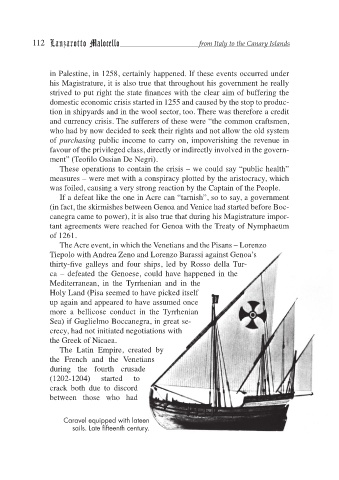
                   Caravel equipped with lateen
                      sails. Late fifteenth century.

