


Page 378 - Lanzarotto Malocello from Italy to the Canary Islands
P. 378
378                                             from Italy to the Canary Islands


                                                                chosen from the
                                                                highest levels of the
                                                                nobility and were
                                                                considered  sacred.
                                                                However,    women
                                                                took part in the reli-
                                                                gion too; there were
                                                                priestesses who had
                                                                a primary role in so-
                                                                ciety  (and  belonged
                                                                to the nobility) who
                                                                would remain  vir-
                                                                gin and live in con-
                                                                vents called  “tamo-
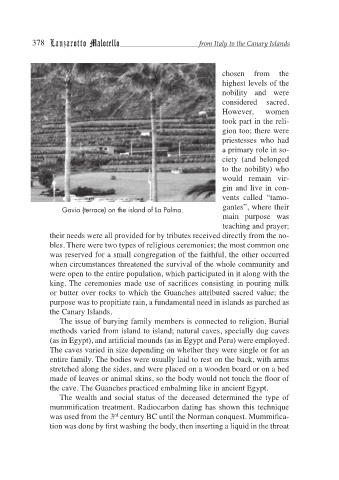
                   Gavia (terrace) on the island of La Palma.   gantes”, where their
                                                                main purpose was
                                                                teaching and prayer;
               their needs were all provided for by tributes received directly from the no-
               bles. There were two types of religious ceremonies; the most common one
               was reserved for a small congregation of the faithful, the other occurred
               when circumstances threatened the survival of the whole community and
               were open to the entire population, which participated in it along with the
               king. The ceremonies made use of sacrifices consisting in pouring milk
               or butter over rocks to which the Guanches attributed sacred value; the
               purpose was to propitiate rain, a fundamental need in islands as parched as
               the Canary Islands.
                  The issue of burying family members is connected to religion. Burial
               methods varied from island to island; natural caves, specially dug caves
               (as in Egypt), and artificial mounds (as in Egypt and Peru) were employed.
               The caves varied in size depending on whether they were single or for an
               entire family. The bodies were usually laid to rest on the back, with arms
               stretched along the sides, and were placed on a wooden board or on a bed
               made of leaves or animal skins, so the body would not touch the floor of
               the cave. The Guanches practiced embalming like in ancient Egypt.
                  The wealth and social status of the deceased determined the type of
               mummification treatment. Radiocarbon dating has shown this technique
               was used from the 3  century BC until the Norman conquest. Mummifica-
                                  rd
               tion was done by first washing the body, then inserting a liquid in the throat

