


Page 82 - Lanzarotto Malocello from Italy to the Canary Islands
P. 82
82                                             from Italy to the Canary Islands


               The Ligurian scene in the

               Late Middle Ages


                     n  De  Bello  Civile
                     Julius Caesar stated:
                     “Navigare     necesse
               est”  (sailing  is  necessary).
               This must be the epitaph
               most forged in bronze for the
               historically  dead  marineria
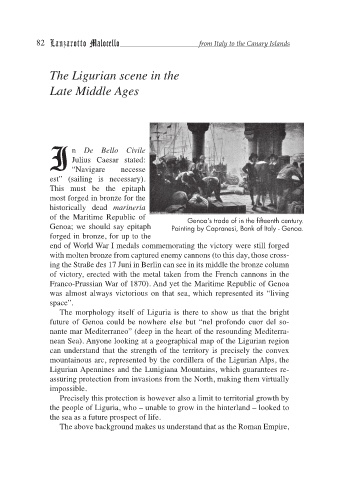
               of the Maritime Republic  of           Genoa’s trade of in the fifteenth century.
               Genoa; we should say epitaph       Painting by Capranesi, Bank of Italy - Genoa.
               forged in bronze, for up to the
               end of World War I medals commemorating the victory were still forged
               with molten bronze from captured enemy cannons (to this day, those cross-
               ing the Straße des 17 Juni in Berlin can see in its middle the bronze column
               of victory, erected with the metal taken from the French cannons in the
               Franco-Prussian War of 1870). And yet the Maritime Republic of Genoa
               was almost always victorious on that sea, which represented its “living
               space”.
                  The morphology itself of Liguria is there to show us that the bright
               future of Genoa could be nowhere else but “nel profondo cuor del so-
               nante mar Mediterraneo” (deep in the heart of the resounding Mediterra-
               nean Sea). Anyone looking at a geographical map of the Ligurian region
               can understand that the strength of the territory is precisely the convex
               mountainous arc, represented by the cordillera of the Ligurian Alps, the
               Ligurian Apennines and the Lunigiana Mountains, which guarantees re-
               assuring protection from invasions from the North, making them virtually
               impossible.
                  Precisely this protection is however also a limit to territorial growth by
               the people of Liguria, who – unable to grow in the hinterland – looked to
               the sea as a future prospect of life.
                  The above background makes us understand that as the Roman Empire,

