


Page 69 - The Secret War in the Italian front in WWI (1915-1918)
P. 69
CHAPTER FOUR


                  The original name of the Office changed to Intelligence Office again,
                  when the encoding service was assigned to the General  Affairs
                  Division on 30 June .
                                    9
                  In August, the War Situation Office merged with the Armies Office
                  into the “War Situation and Operations Office”. Unlike the previous
                  organisation,  this  new important  structure  liaised  with  both  the
                  Secretariat Office of the Chief of the Army Staff and the Headquarters
                  of the Armies concerning the Army operations .
                                                             10
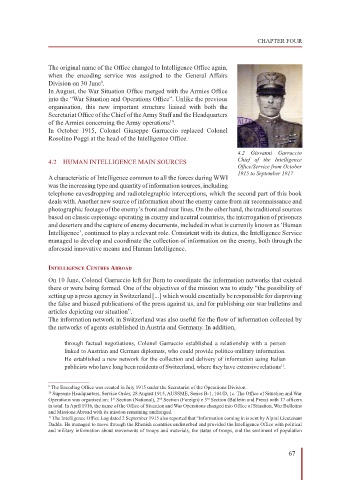
                  In October 1915, Colonel Giuseppe Garruccio replaced Colonel
                  Rosolino Poggi at the head of the Intelligence Office.


                                                                                    4.2  Giovanni  Garruccio
                  4.2  HUMAN INTELLIGENCE MAIN SOURCES                              Chief  of  the  Intelligence
                                                                                    Office/Service from October
                                                                                    1915 to September 1917
                  A characteristic of Intelligence common to all the forces during WWI
                  was the increasing type and quantity of information sources, including
                  telephone eavesdropping and radiotelegraphic interceptions, which the second part of this book
                  deals with. Another new source of information about the enemy came from air reconnaissance and
                  photographic footage of the enemy’s front and rear lines. On the other hand, the traditional sources
                  based on classic espionage operating in enemy and neutral countries, the interrogation of prisoners
                  and deserters and the capture of enemy documents, included in what is currently known as ‘Human
                  Intelligence’, continued to play a relevant role. Consistent with its duties, the Intelligence Service
                  managed to develop and coordinate the collection of information on the enemy, both through the
                  aforesaid innovative means and Human Intelligence.


                  InTellIgence cenTres abroad
                  On 10 June, Colonel Garruccio left for Bern to coordinate the information networks that existed
                  there or were being formed. One of the objectives of the mission was to study “the possibility of
                  setting up a press agency in Switzerland [...] which would essentially be responsible for disproving
                  the false and biased publications of the press against us, and for publishing our war bulletins and
                  articles depicting our situation”.
                  The information network in Switzerland was also useful for the flow of information collected by
                  the networks of agents established in Austria and Germany. In addition,

                        through  factual negotiations,  Colonel  Garruccio  established a  relationship  with  a  person
                        linked to Austrian and German diplomats, who could provide politico-military information.
                        He established a new network for the collection and delivery of information using Italian
                        publicists who have long been residents of Switzerland, where they have extensive relations .
                                                                                                    11

                  9  The Encoding Office was created in July 1915 under the Secretariat of the Operations Division.
                  10  Supreme Headquarters, Service Order, 28 August 1915, AUSSME, Series B-1, 104/D, 1c. The Office of Situation and War
                  Operations was organised on: 1  Section (National), 2  Section (Foreign) e 3  Section (Bulletin and Press) with 17 officers
                                                                          rd
                                         st
                                                         nd
                  in total. In April 1916, the name of the Office of Situation and War Operations changed into Office of Situation, War Bulletins
                  and Missions Abroad with its mission remaining unchanged.
                  11  The Intelligence Office Log dated 2 September 1915 also reported that “Information coming in is sent by Alpini Lieutenant
                  Dadda. He managed to move through the Rhenish countries undisturbed and provided the Intelligence Office with political
                  and military information about movements of troops and materials, the status of troops, and the sentiment of population

                                                                                                      67

