


Page 68 - The Secret War in the Italian front in WWI (1915-1918)
P. 68
THE SECRET WAR ON THE ITALIAN FRONT IN WWI (1915 – 1918)


              About the Intelligence Offices of the Armies, O. Marchetti wrote: “they initially consisted of a
              Captain as the head of the office and some other officer and continued to work as in the detached
              offices they came from. […] Soon the heads of those offices found themselves engaged with
              prisoners and deserters, who became the almost exclusive focus of their activities” .
                                                                                          5
              General Order 1 of 26 May summarised the organisation and mission of the Intelligence Office. In
              addition to a Secretariat and two Intelligence Sections, it embraced the following sections: Military
              Police and Counterintelligence; Encoding; Translators and Interpreters; Available Officers and,
              where appropriate, the Press Section .
                                                6
              Each Intelligence Section, responsible for two distinct areas of the front, included a Military Intelligence
              Unit dealing with information on composition, strength, location, and movements of opposing troops;
                                                                                a Field and Politico-
                                                                                Military     Intelligence
                                                                                Unit, and a Situation and
                                                                                Correspondence    Team
                                                                                which updated the locations
                                                                                of both national and enemy
                                                                                troops of the opposing forces
                                                                                on detailed maps. It also
                                                                                dealt with correspondence
                                                                                with the depending agents.
                                                                                On 25 May, the  War
                                                                                Situation  Office  was  also
                                                                                mobilised in  Treviso and
                                                                                assigned to Lieutenant
                                                                                Colonel Alberico Albricci.
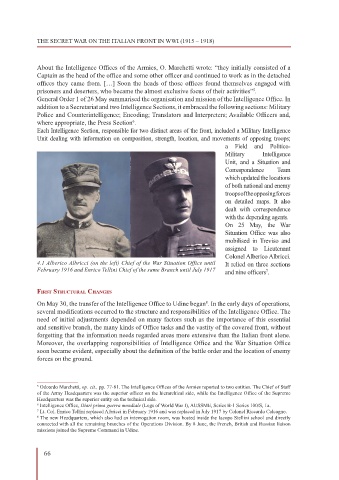
              4.1 Alberico Albricci (on the left) Chief of the War Situation Office until   It relied on three sections
              February 1916 and Enrico Tellini Chief of the same Branch until July 1917  and nine officers .
                                                                                              7


              fIrsT sTrucTural changes

              On May 30, the transfer of the Intelligence Office to Udine began . In the early days of operations,
                                                                         8
              several modifications occurred to the structure and responsibilities of the Intelligence Office. The
              need of initial adjustments depended on many factors such as the importance of this essential
              and sensitive branch, the many kinds of Office tasks and the vastity of the covered front, without
              forgetting that the information needs regarded areas more extensive than the Italian front alone.
              Moreover, the overlapping responsibilities of Intelligence Office and the War Situation Office
              soon became evident, especially about the definition of the battle order and the location of enemy
              forces on the ground.


              5  Odoardo Marchetti, op. cit., pp. 77-81. The Intelligence Offices of the Armies reported to two entities. The Chief of Staff
              of the Army Headquarters was the superior officer on the hierarchical side, while the Intelligence Office of the Supreme
              Headquarters was the superior entity on the technical side.
              6  Intelligence Office, Diari prima guerra mondiale (Logs of World War I), AUSSME, Series B-1 Series 100/S, 1a.
              7  Lt. Col. Enrico Tellini replaced Albricci in February 1916 and was replaced in July 1917 by Colonel Riccardo Calcagno.
              8  The new Headquarters, which also had an interrogation room, was hosted inside the Iacopo Stellini school and directly
              connected with all the remaining branches of the Operations Division. By 8 June, the French, British and Russian liaison
              missions joined the Supreme Command in Udine.


                66

