


Page 73 - The Secret War in the Italian front in WWI (1915-1918)
P. 73
CHAPTER FOUR


                  During 1917 and 1918, brochures were published containing statistical data on origin, unit,
                  physical state, age, previous job, level of education, etc. of prisoners and deserters, as well
                  as excerpts of depositions and opinions about the progress of the war, the political and economic
                  conditions of the Dual Monarchy, and the morale of the population .
                                                                               21
                  Ronge himself recognised “the ability of the Italian Intelligence Service in questioning prisoners
                  with the use of suitably trained trustees” .
                                                       22


                  caPTured docuMenTs
                  The analysis of personal and
                  military  documents  found
                  on captured prisoners and
                  deserters, or corps of enemy
                  soldiers,  often   resulted
                  useful for the intelligence
                  service.  A paragraph  of
                  the  Norme  generali  per
                  il   servizio   informazioni
                  sul    nemico     (General
                  Rules for the  Intelligence
                  Service  against  the  enemy)
                  highlighted “the importance
                  of     information     that
                  documents can reveal, even
                  those of apparently no value,
                  when they are examined by
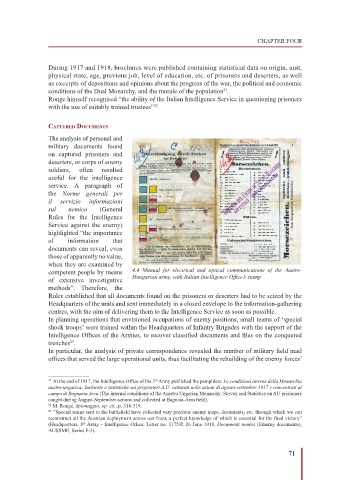
                  competent people by means    4.4  Manual  for  electrical  and  optical  communications  of  the  Austro-
                  of extensive  investigative   Hungarian army, with Italian Intelligence Office’s stamp
                  methods”.  Therefore,  the
                  Rules established that all documents found on the prisoners or deserters had to be seized by the
                  Headquarters of the units and sent immediately in a closed envelope to the information-gathering
                  centres, with the aim of delivering them to the Intelligence Service as soon as possible.
                  In planning operations that envisioned occupations of enemy positions, small teams of ‘special
                  shock troops’ were trained within the Headquarters of Infantry Brigades with the support of the
                  Intelligence Offices of the Armies, to recover classified documents and files on the conquered
                  trenches .
                          23
                  In particular, the analysis of private correspondence revealed the number of military field mail
                  offices that served the large operational units, thus facilitating the rebuilding of the enemy forces’


                  21   At the end of 1917, the Intelligence Office of the 3  Army published the pamphlets: Le condizioni interne della Monarchia
                                                       rd
                  austro-ungarica: Inchieste e statistiche sui prigionieri A.U. catturati nelle azioni di agosto-settembre 1917 e concentrati al
                  campo di Bagnaria Arsa (The internal conditions of the Ausrtro Ungarian Monarchy: Survey and Statistics on AU prisioners
                  caught during August-September actions and collected at Bagnaia-Arsa field).
                  22  M. Ronge, Spionaggio, op. cit., p. 318-319.
                  23   ”Special teams sent to the battlefield have collected very precious enemy maps, documents, etc. through which we can
                  reconstruct all the Austrian deployment across our front, a perfect knowledge of which is essential for the final victory”
                  (Headquarters, 8  Army - Intelligence Office, Letter no. 1175/P, 26 June 1918, Documenti nemici (Ememy documents),
                              th
                  AUSSME, Series F-3).


                                                                                                      71

