


Page 78 - The Secret War in the Italian front in WWI (1915-1918)
P. 78
THE SECRET WAR ON THE ITALIAN FRONT IN WWI (1915 – 1918)


              One relevant publication produced by the I Office was the Notiziario sullo spirito delle truppe
              (Newsletter on the morale of troops), a confidential report taken mostly from mail censorship
              including also excerpts of letters from or to military personnel. These newsletters summarized
              the reasons for soldiers’ discontent and contained several news about their disciplinary behaviour,
              reporting the frequent requests found in letters from first line soldiers for specific advice on how
              “to generate eye infections or cause other wounds that may exempt them from service” . In
                                                                                                  44
              the newsletter of April 1917, for example, the issue of self-inflicted wounds, was addressed and
              considered a sign of concerns for the next spring offensive.
              For  the  censorship  of  foreign  mail,  offices  were  established  in  Bologna,  Milan,  and  Genoa,
              including both civilian and military personnel . Under agreements with the Allied powers, all
                                                         45
              correspondence between Italy and neutral states as well as between the neutral countries transiting
              through Italy, had to be censored. The heads of censorship departments were in direct contact with
              the Supreme Command’s I Office, while the territorial Army Corps’ Headquarters exercised their
              superior powers and surveillance over the service . Since June 1916, the Military Censorship
                                                             46
              Office set up at the Secretariat-General of the Ministry of War started to exert its authority on the
              international mail censorship offices, taking on many
              of the previous duties of Intelligence Office .
                                                      47


              ProPaganda
              At the beginning of the conflict, propaganda among
              troops existed mainly in verbal form and was delivered
              by military officers and sometime by lecturers foreign
              to  the  Army.  Written  propaganda  through  leaflets,
              pamphlets,  trench newspapers and proclamations,
              while significant, was not as developed in its early
              stages of war as in the following years.
              The Operations Division took care of propaganda and
              press  control.  The  Situation  Office  drafted  the  war
              bulletins of the Supreme Command; the Intelligence
              Office  released  communications  on  operations  to
              the  press;  the  Secretariat  maintained  relations  with
              the Government and with the political and military
              authorities of the allied countries. As such a separation
              of  tasks  prevented  a  unified  propaganda,  at  the
              beginning of 1916, the Supreme Command decided
              to create a Press Office to document war events both
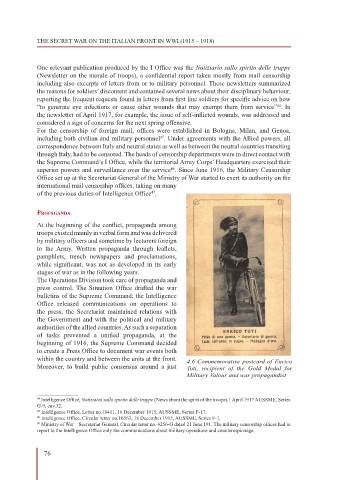
              within the country and between the units at the front.   4.6 Commemorative postcard of Enrico
              Moreover, to build public consensus around a just    Toti,  recipient  of  the  Gold  Medal  for
                                                                   Military Valour and war propagandist


              44  Intelligence Office, Notiziario sullo spirito delle truppe (News about the spirit of the troops),1 April 1917 AUSSME, Series
              G-9, env.32.
              45  Intelligence Office, Letter no.10411, 16 December 1915, AUSSME, Series F-17.
              46  Intelligence Office, Circular letter no.10563, 18 December 1915, AUSSME, Series F-1.
              47  Ministry of War – Secretariat General, Circular letter no. 6256-G dated 21 June 191. The military censorship offices had to
              report to the Intelligence Office only the communications about military operations and counterespionage.


                76

