


Page 75 - The Secret War in the Italian front in WWI (1915-1918)
P. 75
CHAPTER FOUR


                  However, with a view of not altering the ordinary life of the country, unless indispensable to protect
                  military security, “the closer to the front lines within the area of war, the tighter the protection
                  measures restricting personal freedom” .
                                                      29


                  The fIghT agaInsT eneMy saboTage and InTernal defeaTIsM
                  Counterespionage  tried  to curb
                  enemy  espionage,  which  in 1916
                  led  to sabotage  actions  against
                  industrial  plants  responsible for
                  war    production,    ammunition
                  depots and even warships. In the
                  spring of that year, an organisation
                  of Italian  traitors  was disbanded,
                  which had damaged  the steelwork
                  factory in  Terni and the dynamite
                  factory in Cengio, as well as some
                  railway lines and power plants. This
                  operation started with the arrest in
                  Terni on 17 May 1916 of a certain
                  Giuseppe  Larese,  while  he  was
                  trying  to  blow up the  steelwork
                  factory with special gelatine pipes
                  smuggled from Austria .
                                       30
                  The I Office was actively engaged
                  in countering the intensification of
                  subversive  anti-war  actions,  also
                  by infiltrating agents in extremists’
                  organisations.   In    describing
                  the work against the spread of
                  defeatist  propaganda within the
                  Army, Garruccio  acknowledged
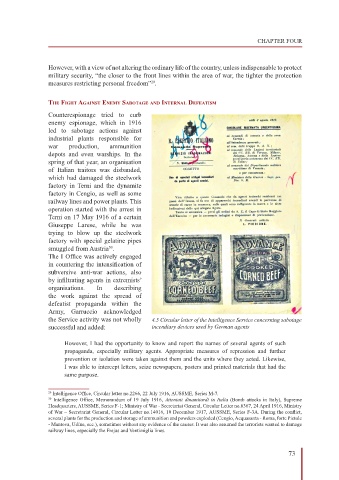
                  the Service activity was not wholly   4.5 Circular letter of the Intelligence Service concerning sabotage
                  successful and added:               incendiary devices used by German agents

                        However, I had the opportunity to know and report the names of several agents of such
                        propaganda,  especially  military agents.  Appropriate  measures  of repression and further
                        prevention or isolation were taken against them and the units where they acted. Likewise,
                        I was able to intercept letters, seize newspapers, posters and printed materials that had the
                        same purpose.


                  29  Intelligence Office, Circular letter no.2266, 22 July 1916, AUSSME, Series M-7.
                  30   Intelligence  Office,  Memorandum  of  19  July  1916,  Attentati  dinamitardi  in  Italia  (Bomb attacks  in Italy),  Supreme
                  Headquarters, AUSSME, Series F-1; Ministry of War - Secretariat General, Circular Letter no.6367, 24 April 1916, Ministry
                  of War – Secretariat General, Circular Letter no.14016, 10 December 1917, AUSSME, Series F-3A. During the conflict,
                  several plants for the production and storage of ammunition and powders exploded (Cengio, Acquasanta - Roma, forte Pietole
                  - Mantova, Udine, ecc.), sometimes without any evidence of the causes. It was also assumed the terrorists wanted to damage
                  railway lines, especially the Frejus and Ventimiglia lines.


                                                                                                      73

