


Page 71 - The Secret War in the Italian front in WWI (1915-1918)
P. 71
CHAPTER FOUR


                  Austro-Hungarian armies, the progress of operations at the front, and the economic and financial
                  situations.
                  The exchange of information with the Allied intelligence services was of utmost importance for
                  the reconstruction of the war scenarios of the enemy powers and the deployment of their higher
                  echelons on the European fronts. Cooperation with the Russian mission was crucial to control the
                  frequent movements of the Austro-Hungarian units from the eastern front to the Italian one and vice
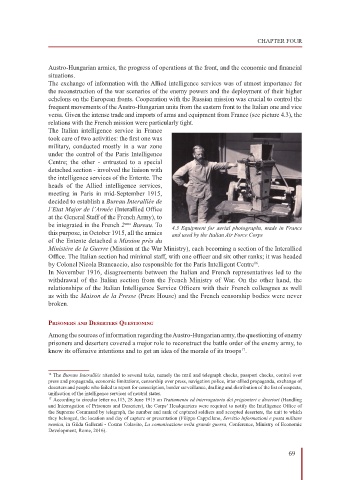
                  versa. Given the intense trade and imports of arms and equipment from France (see picture 4.3), the
                  relations with the French mission were particularly tight.
                  The  Italian  intelligence  service  in France
                  took care of two activities: the first one was
                  military, conducted  mostly in a war zone
                  under the control of the Paris Intelligence
                  Centre;  the  other  -  entrusted  to  a  special
                  detached section - involved the liaison with
                  the intelligence services of the Entente. The
                  heads of the  Allied intelligence services,
                  meeting  in Paris in mid-September  1915,
                  decided to establish a Bureau Interallìée de
                  l’Etat Major de l’Armée (Interallied Office
                  at the General Staff of the French Army), to
                  be integrated in the French 2  Bureau. To   4.3 Equipment for aerial photographs, made in France
                                             eme
                  this purpose, in October 1915, all the armies   and used by the Italian Air Force Corps
                  of the Entente detached a Mission près du
                  Ministère de la Guerre (Mission at the War Ministry), each becoming a section of the Interallied
                  Office. The Italian section had minimal staff, with one officer and six other ranks; it was headed
                  by Colonel Nicola Brancaccio, also responsible for the Paris Intelligent Centre .
                                                                                          16
                  In November 1916, disagreements between the Italian and French representatives led to the
                  withdrawal of the Italian section from the French Ministry of War. On the other hand, the
                  relationships of the Italian Intelligence Service Officers with their French colleagues as well
                  as with the Maison de la Presse (Press House) and the French censorship bodies were never
                  broken.


                  PrIsoners and deserTers quesTIonIng
                  Among the sources of information regarding the Austro-Hungarian army, the questioning of enemy
                  prisoners and deserters covered a major role to reconstruct the battle order of the enemy army, to
                  know its offensive intentions and to get an idea of the morale of its troops .
                                                                                      17


                  16  The Bureau Interallìès attended to several tasks, namely the mail and telegraph checks, passport checks, control over
                  press and propaganda, economic limitations, censorship over press, navigation police, inter-allied propaganda, exchange of
                  deserters and people who failed to report for conscription, border surveillance, drafting and distribution of the list of suspects,
                  unification of the intelligence services of neutral states.
                  17   According to circular letter no.113, 28 June 1915 on Trattamento ed interrogatorio dei prigionieri e disertori (Handling
                  and Interrogation of Prisoners and Deserters), the Corps’ Headquarters were required to notify the Intelligence Office of
                  the Supreme Command by telegraph, the number and rank of captured soldiers and accepted deserters, the unit to which
                  they belonged, the location and day of capture or presentation (Filippo Cappellano, Servizio Informazioni e posta militare
                  nemica, in Gilda Gallerati - Cosmo Colavito, La comunicazione nella grande guerra, Conference, Ministry of Economic
                  Development, Rome, 2016).


                                                                                                      69

