


Page 82 - The Secret War in the Italian front in WWI (1915-1918)
P. 82
THE SECRET WAR ON THE ITALIAN FRONT IN WWI (1915 – 1918)


              d’Assa, and Vallarsa. The advance of the infantry would
              take place after a violent preparation fire by the artillery,
              with a large amount of artillery pieces being allegedly
              amassed on the Plateaus. [...] Continuous movements of
              railroad, of infantry troops and artillery are taking place
              everywhere along the entire front of the Corps, from
              the Adige to the Brenta” . The offensive preparation
                                      61
              was confirmed by air reconnaissance and by reports on
              departures of units from the Isonzo front to Trentino.
              In April, the Intelligence Office of the Headquarters,
              1  Army guessed the almost exact layout of the enemy
               st
              deployment. The serious threat that was building against
              the  1  Army  was also  perceived  by  the  Intelligence
                   st
              Office of the Supreme Command which, in its Bulletin
              no. 2307 on 23 April, considered “the offensive likely
              to be carried out shortly on the southern Trentino front,
              perhaps in a week or two at the most” . In addition to
                                                 62
              correctly forecasting the attack zone, the period of the
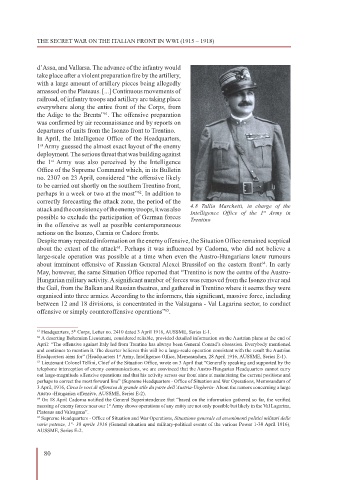
              attack and the consistency of the enemy troops, it was also   4.8  Tullio  Marchetti,  in  charge  of  the
                                                                    Intelligence  Office  of  the  1   Army  in
                                                                                              st
              possible to exclude the participation of German forces   Trentino
              in the offensive as well as possible contemporaneous
              actions on the Isonzo, Carnia or Cadore fronts.
              Despite many repeated information on the enemy offensive, the Situation Office remained sceptical
              about the extent of the attack . Perhaps it was influenced by Cadorna, who did not believe a
                                          63
              large-scale operation was possible at a time when even the Austro-Hungarians knew rumours
              about imminent offensive of Russian General Alexei Brussilof on the eastern front . In early
                                                                                             64
              May, however, the same Situation Office reported that “Trentino is now the centre of the Austro-
              Hungarian military activity. A significant number of forces was removed from the Isonzo river and
              the Gail, from the Balkan and Russian theatres, and gathered in Trentino where it seems they were
              organised into three armies. According to the informers, this significant, massive force, including
              between 12 and 18 divisions, is concentrated in the Valsugana - Val Lagarina sector, to conduct
              offensive or simply counteroffensive operations” .
                                                           65


                           th
              61  Headquarters, 5  Corps, Letter no. 2410 dated 3 April 1916, AUSSME, Series E-1.
              62  A deserting Bohemian Lieutenant, considered reliable, provided detailed information on the Austrian plans at the end of
              April: “The offensive against Italy led from Trentino has always been General Conrad’s obsession. Everybody mentioned
              and continues to mention it. The deserter believes this will be a large-scale operation consistent with the result the Austrian
              Headquarters aims for” (Headquarters 1  Army, Intelligence Office, Memorandum, 28 April 1916, AUSSME, Series E-1).
                                           st
              63  Lieutenant Colonel Tellini, Chief of the Situation Office, wrote on 3 April that “Generally speaking and supported by the
              telephone interception of enemy communications, we are convinced that the Austro-Hungarian Headquarters cannot carry
              out large-magnitude offensive operations and that his activity across our front aims at maintaining the current positions and
              perhaps to correct the most forward line” (Supreme Headquarters - Office of Situation and War Operations, Memorandum of
              3 April, 1916, Circa le voci di offensiva di grande stile da parte dell’Austria-Ungheria- About the rumors concerning a large
              Austro -Hungarian offensive, AUSSME, Series E-2).
              64  On 18 April Cadorna notified the General Superintendence that “based on the information gathered so far, the verified
              massing of enemy forces near our 1  Army shows operations of any entity are not only possible but likely in the Val Lagarina,
                                       st
              Plateaus and Valsugana”.
              65  Supreme Headquarters - Office of Situation and War Operations, Situazione generale ed avvenimenti politici militari delle
              varie potenze, 1°- 30 aprile 1916 (General situation and military-political events of the various Power 1-30 April 1916),
              AUSSME, Series E-2.


                80

