


Page 81 - The Secret War in the Italian front in WWI (1915-1918)
P. 81
CHAPTER FOUR


                  with the aim  of knowing “with  the
                  best precision, not only the location,
                  but  also  the  features  of  the  enemy
                  defences such as their robustness, the
                  artillery and machine guns positions,
                  the observation posts, the shelters,
                  etc. The surveillance was developed
                  with all the available means, both on
                  land and in the air […]. The accurate
                  observation  of  artillery  ‘flashes’  at
                  night was instrumental in determining
                  the positions of the  enemy  artillery
                  with   greater  precision” .   The
                                            59
                  perfect  knowledge  of  the  enemy’s
                  defensive  preparations,  therefore,
                  became indispensable premise for
                  any offensive operation, from the big
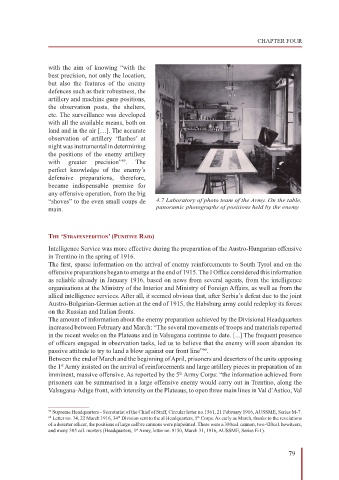
                  “shoves” to the even small coups de   4.7 Laboratory of photo team of the Army. On the table,
                  main.                                 panoramic photographs of positions held by the enemy


                  The ‘sTrafexPedITIon’ (PunITIve raId)

                  Intelligence Service was more effective during the preparation of the Austro-Hungarian offensive
                  in Trentino in the spring of 1916.
                  The first, sparse information on the arrival of enemy reinforcements to South Tyrol and on the
                  offensive preparations began to emerge at the end of 1915. The I Office considered this information
                  as reliable already in January 1916, based on news from several agents, from the intelligence
                  organisations at the Ministry of the Interior and Ministry of Foreign Affairs, as well as from the
                  allied intelligence services. After all, it seemed obvious that, after Serbia’s defeat due to the joint
                  Austro-Bulgarian-German action at the end of 1915, the Habsburg army could redeploy its forces
                  on the Russian and Italian fronts.
                  The amount of information about the enemy preparation achieved by the Divisional Headquarters
                  increased between February and March: “The several movements of troops and materials reported
                  in the recent weeks on the Plateaus and in Valsugana continue to date. [...] The frequent presence
                  of officers engaged in observation tasks, led us to believe that the enemy will soon abandon its
                  passive attitude to try to land a blow against our front line” .
                                                                        60
                  Between the end of March and the beginning of April, prisoners and deserters of the units opposing
                  the 1  Army insisted on the arrival of reinforcements and large artillery pieces in preparation of an
                      st
                  imminent, massive offensive. As reported by the 5  Army Corps: “the information achieved from
                                                                th
                  prisoners can be summarised in a large offensive enemy would carry out in Trentino, along the
                  Valsugana-Adige front, with intensity on the Plateaus, to open three main lines in Val d’Astico, Val


                  59  Supreme Headquarters - Secretariat of the Chief of Staff, Circular letter no.1561, 21 February 1916, AUSSME, Series M-7.
                                                                      th
                  60  Letter no. 74, 22 March 1916, 34  Division sent to the al Headquarters, 5  Corps. As early as March, thanks to the revelations
                                          th
                  of a deserter officer, the positions of large calibre cannons were pinpointed. These were a 380cal. cannon, two 420cal. howitzers,
                  and many 305 cal. mortars (Headquarters, 1  Army, letter no. 8150, March 31, 1916, AUSSME, Series E-1).
                                                 st
                                                                                                      79

