


Page 86 - The Secret War in the Italian front in WWI (1915-1918)
P. 86
THE SECRET WAR ON THE ITALIAN FRONT IN WWI (1915 – 1918)


                    Regarding the relationships between the Intelligence Office and the Situation Office, the latter
                    never really accepted to receive from the former all the information it needed to keep the Chief
                    of Staff constantly abreast of the situation of enemy forces […]. Therefore, it had organized its
                    own irregular intelligence service, which tended to overlap with the regular service performed
                    by my branch. […] The competing Office always managed to impose its own views, especially
                    because of the more frequent and direct contacts it could keep, due to the specific nature of
                    its own functions, with the Secretariat of the Supreme Commander and with him personally.
                    Thus, after about a year of troubles and frictions, I finally succeeded in implementing a more
                    rational distribution of tasks between the two Offices .
                                                                5

              The reorganIzaTIon of The InTellIgence secTor
              In October 1916, the  Intelligence  of the  Army was
              completely reorganized and subdivided into two distinct
              areas. One of them, dealing with the war zone, was assigned
              to the War Situation and Operations Office of the Supreme
              Command, which incorporated the first two sections of
              the  Intelligence  Office . The  Intelligence  Offices  of  the
                                   6
              Armies were placed under its technical supervision. The
              other sector  comprehensive of the remaining  parts of
              the  previous  Intelligent  Office  and  named  ‘Intelligence
              Service of the Supreme Command’, dealt with the rear
              line and foreign countries. Its main branch was transferred
              from Udine to Rome.
              As a matter of fact, the Intelligence Office/Service lost part
              of its responsibilities regarding the reconstruction of the
              enemy military organization - which was assigned to the
              Situation Office - and focussed on the relationships with
              centres abroad and with the missions to Allied Countries,
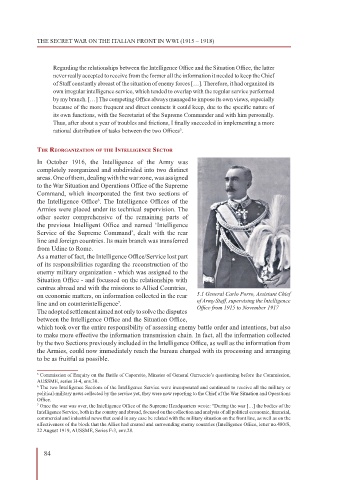
              on economic matters, on information collected in the rear   5.1 General Carlo Porro, Assistant Chief
              line and on counterintelligence .                       of Army Staff, supervising the Intelligence
                                          7
              The adopted settlement aimed not only to solve the disputes   Office from 1915 to November 1917
              between the Intelligence Office and the Situation Office,
              which took over the entire responsibility of assessing enemy battle order and intentions, but also
              to make more effective the information transmission chain. In fact, all the information collected
              by the two Sections previously included in the Intelligence Office, as well as the information from
              the Armies, could now immediately reach the bureau charged with its processing and arranging
              to be as fruitful as possible.


              5  Commission of Enquiry on the Battle of Caporetto, Minutes of General Garruccio’s questioning before the Commission,
              AUSSME, series H-4, env.30.
              6  The two Intelligence Sections of the Intelligence Service were incorporated and continued to receive all the military or
              political-military news collected by the service yet, they were now reporting to the Chief of the War Situation and Operations
              Office.
              7  Once the war was over, the Intelligence Office of the Supreme Headquarters wrote: “During the war […] the bodies of the
              Intelligence Service, both in the country and abroad, focused on the collection and analysis of all political economic, financial,
              commercial and industrial news that could in any case be related with the military situation on the front line, as well as on the
              effectiveness of the block that the Allies had created and surrounding enemy countries (Intelligence Office, letter no.480/S,
              22 August 1919, AUSSME, Series F-3, env.28.


                84

