


Page 73 - Airpower in 20th Century - Doctrines and Employment
P. 73
73
            InconclusIve experIment – brItIsh AIr power And the suez crIsIs, 1956. the AllIed AIr cAmpAIgn reAssessed


            raising to 200 meters, due to the flak, for example, would multiply the amount of
                         66
            sorties by four.
               Nasser realised the importance of radio as a means to deliver his message to the
            masses. The propaganda of Radio Cairo had been a nuisance for the British for some
            time. As a result, Radio Cairo and its substations were among primary targets for the
            Allied bomber effort.
               The  final  phase  of  air  operations  was  designed  to  support  the  landing  and
            occupation of the Canal Zone. Majority of the efforts by ground attack planes would
            be directed to isolate the battle area, to suppress AA-defences and to provide direct
            support to the landing force, including an airborne landing in co-ordination with the
                                 67
            Joint Fire Support Plan.
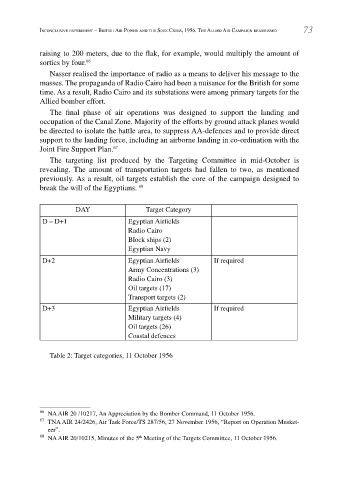
               The  targeting  list  produced  by  the  Targeting  Committee  in  mid-October  is
            revealing.  The  amount  of  transportation  targets  had  fallen  to  two,  as  mentioned
            previously. As a result, oil targets establish the core of the campaign designed to
                                         68
            break the will of the Egyptians.

                       DAY                 Target Category
             D – D+1                 Egyptian Airfields
                                     Radio Cairo
                                     Block ships (2)
                                     Egyptian Navy
             D+2                     Egyptian Airfields       If required
                                     Army Concentrations (3)
                                     Radio Cairo (3)
                                     Oil targets (17)
                                     Transport targets (2)
             D+3                     Egyptian Airfields       If required
                                     Military targets (4)
                                     Oil targets (26)
                                     Coastal defences

               Table 2: Target categories, 11 October 1956


            66
                NA AIR 20 /10217, An Appreciation by the Bomber Command, 11 October 1956.
            67
                TNA AIR 24/2426, Air Task Force/TS 287/56, 27 November 1956, “Report on Operation Musket-
               eer”.
            68                           th
                NA AIR 20/10215, Minutes of the 5  Meeting of the Targets Committee, 11 October 1956.

