


Page 60 - Il Mediterraneo quale elemento del Potere Marittimo - Atti 16-18 settembre 1996
P. 60
46                                                              YOCHI  HIRAMA

           the Navy again, but finally, the Japanese Navy accepted to send two trawlers, Tokyo
           (Japanese name Tokyo)  and Miningsby (Saikyo)  of the Royal Navy on 11th June, and
           two British H-class destroyers Nemesis (Sendan),  and Minstrel (Kanran) in September
                               4
           and in October  1917 < 1).  On 21st October, the British Navy again asked Naval
           Attache for two cruisers to the Mediterranean but the Imperial Navy refused. Am-
           bassador Chinda met Minister Sir Arthur James Balfour on  13th November and
           clearly denied request, repeating that to send battle-cruiser to European waters would
                                                     2
           cause  the depletion  of the  national defence <4 >.
               In addition, on 23rd February and 9thJune, having received Admiral Gough-
           Calthorpe·s communication for further assistance, Rear Admiral Sato telegraphed
           this message adding his opinion that the sending of another destroyer,  would be
           effective tactical research for  anti-submarine warfare.  But the Japanese Navy did
                            4
           not comply with it  < 3>.  But the Allies,  having seen how the Japanese destroyers had
           provided invaluable support, there arose another requirement from the Italian and
                          4
           French  Navies <4 >.  However,  the Japanese Navy did not comply sayng that they
           had no more vessels available since their naval forces had already been sent to the
           Pacific,  the Indian Ocean, Australian waters,  the Mediterranean and recently to
           Vladivostok and that the situation in Siberia, the unsteady conditions in China and
           the danger of possible German raid in Eastern waters prevented the Japanese Navy
           from sparing any additional forces <45>.  By these continuous refusals, there arosed
           not only antipathy to Japan, but also the suspicion that Japan might be conserving
                                                                         4
           her naval  strength  in  the long  term for  future  use  against  Britain < 6>.
           Evaluation  and activities  of the  Second Special Squadron

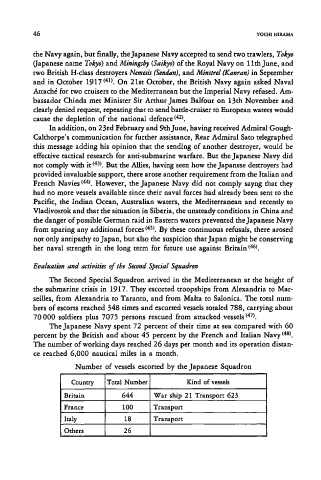
               The Second Special Squadron arrived in the Mediterranean at the height of
           the submarine crisis in  1917. They escorted troopships from Alexandria to Mar-
           seilles,  from  Alexandria to Taranto, and from  Malta to Salonica.  The total num-
           bers of escorts reached 348 times and escorted vessels totaled 788, carrying about
                                                                        47
           70 000 soldiers  plus  7075  persons  rescued  from  attacked .vessels < >.
               The Japanese Navy spent 72  percent of their time at sea compared with 60
                                                                                  48
           percent by the British and about 45  percent by the French and Italian Navy < >.
           The number of working days reached 26 days per month and its operation distan-
           ce  reached  6,000  nautical  miles  in a month.
                       Number of vessels  escorted  by the Japanese Squadron

                      Country   Total Number           Kind of vessels
                    Britain         644      War ship  21  Transport 623
                    France          100      Transport
                    Italy            18      Transport
                    Others           26

