


Page 106 - Lanzarotto Malocello from Italy to the Canary Islands
P. 106
106                                             from Italy to the Canary Islands


                  As often is the case in history, fateful events such as war can give rise
               to a booming economy; the enervating war against the emperor helped to
               secure Genoa a state of relative economic wellbeing. This economically
               favourable period would be followed by another which would bring diffi-
               culties for some professions, especially those in the wool business. It was
               precisely the wool makers who suffered during this new phase of peace;
               kept safe during the war thanks to protectionist measures, they were then
               to experience a crisis due to the reopening to competition across the bor-
               ders, especially from Lombardy.
                  Even  the  case  of the  crusade  ordered  by King Louis IX of France
               brought with it a sublime paradox. Genoa, which had to prepare the fleet
               for the King, used a lot of men for this work, and this meant important job
               orders for the city and a period of social peace.
                  We were speaking of the wool makers’ guild. The Guilds had not yet
               been properly established, but they would become so when a part of the ar-
               istocracy – the “Mascherati”, i.e. the Ghibellines, who were to come onto
               the scene again – supported the demands of the craftsmen.
                  A riot which broke out following the fleeing of the Podestà Filippo
               della Torre in 1256, guilty of ill actions towards merchants from Piacenza,
               sparked the creation of the first form of “people’s government” in Genoa.
                                         Donaver  wrote:  “In  1257 the  Milanese  po-
                                             destà Filippo Della Torre retired from of-
                                                fice; he had proved in his government
                                                  to be a corrupt and defective man,
                                                        the people therefore  wanted
                                                            him  to  be  put  on  trial
                                                                and pleaded that he
                                                                        be punished.


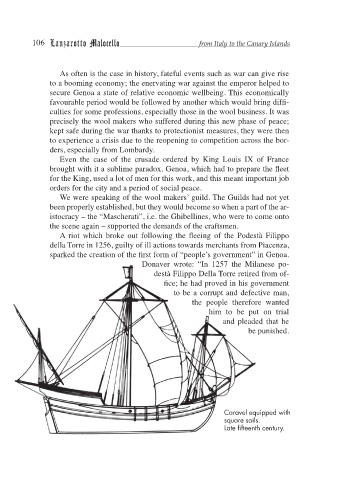
                                                                 Caravel equipped with
                                                                 square sails.
                                                                 Late fifteenth century.

